

AI search is becoming a primary discovery channel for modern consumers. Instead of clicking through blue links, users now ask conversational questions and receive synthesized answers. To win in this environment, businesses must optimize for how generative models retrieve, evaluate, and cite information. This guide outlines seven practical strategies to increase your brand's visibility in AI chatbot responses.
1. Optimize for Question-Based Queries
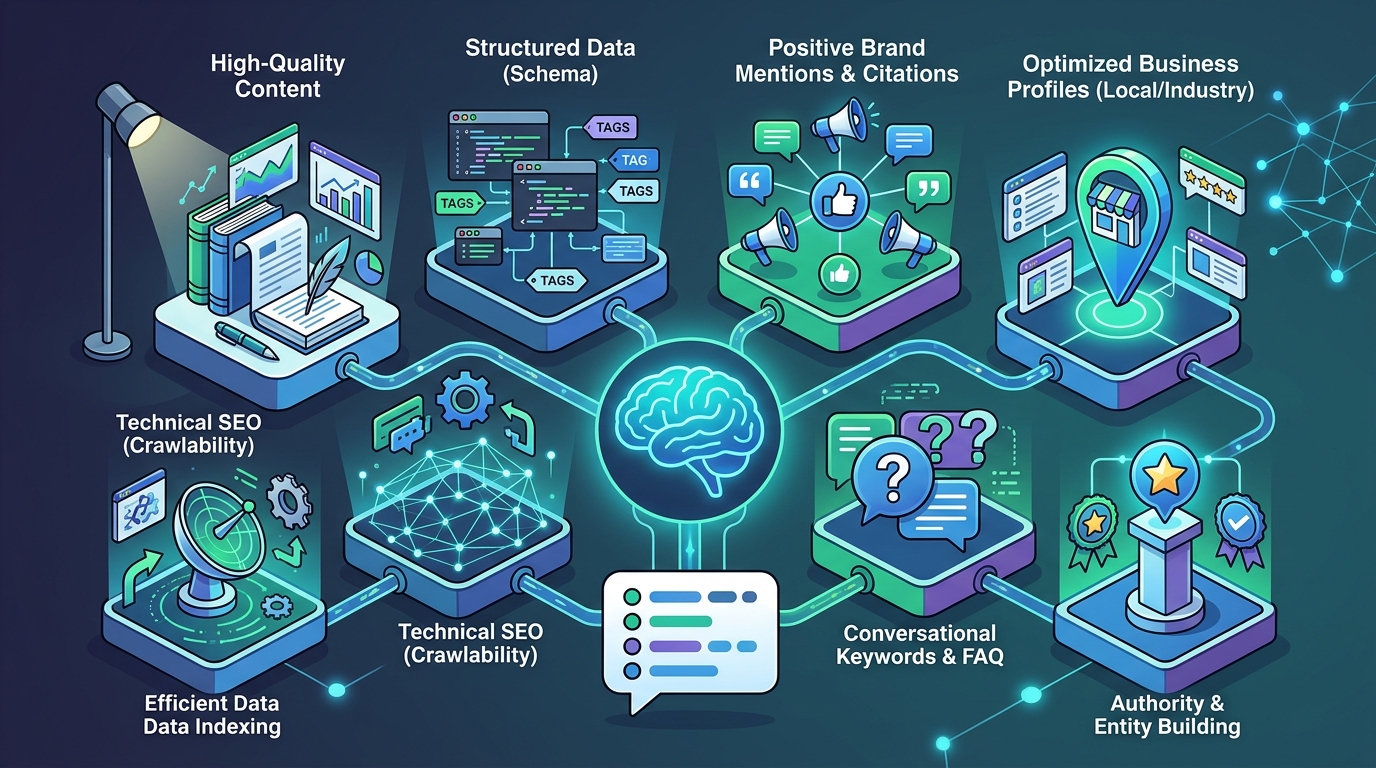
Shift your content strategy from keywords to natural language questions. Traditional SEO relies on short keyword phrases, but AI users ask complex, conversational questions. You should create content that directly answers specific questions your customers are likely to ask. This approach, known as Answer Engine Optimization, helps models extract precise information for their responses.
2. Build a Clear First-Party Information Hub
Your website must serve as the definitive source of truth about your business. AI systems prioritize clear, factual, and easily accessible information. Ensure your site clearly states your services, location, pricing, and credentials without excessive marketing fluff. If your website is ambiguous or outdated, AI models may rely on less accurate third-party sources instead.
3. Secure Third-Party Corroboration
Independent sources validate your claims and increase model trust. A business describing itself is inherently biased, so AI systems look for external confirmation. Earn mentions in respected publications, industry directories, and customer review platforms. This corroboration signals to generative engines that your brand is credible and widely recognized in your sector.
4. Implement Structured Data and Schema
Use schema markup to help machines understand your content context. Structured data provides explicit clues about the meaning of your content. By implementing relevant schema types, you make it easier for AI systems to parse and cite specific details like product features, service areas, or expert credentials. This technical layer supports both traditional search and generative retrieval.
5. Monitor AI Share of Voice
Track your brand's presence across specific AI prompts over time. Unlike traditional rankings, AI visibility is contextual and variable. You need to measure how often your brand appears in answers to high-value commercial questions. This metric, called AI Share of Voice, helps you understand your competitive position and identify gaps in your visibility strategy.
6. Maintain Technical Crawlability
Ensure your site is technically accessible to AI retrieval systems. Generative models often use web search to gather current information. If your site is slow, blocked by robots.txt, or difficult to crawl, it will not be included in the data pool. A technically sound website is the foundation for any AI visibility strategy.
7. Align Content with Commercial Intent
Focus on the questions that lead to actual customer acquisition. Not all AI interactions have equal value. Prioritize content that addresses comparison, recommendation, and transactional queries. These high-intent prompts are more likely to result in a customer choosing your business over a competitor. Aligning your content with these moments maximizes the return on your optimization efforts.
Choosing the Right Strategy
Select your starting point based on your current digital maturity. If your website lacks clear factual information, begin with item 2. If your site is solid but you lack external validation, focus on item 3. For most businesses, a combination of question-based content and technical crawlability provides the strongest foundation for AI visibility.
Frequently Asked Questions
What is AI Share of Voice?
AI Share of Voice is a metric that measures how often a brand appears in AI-generated answers compared to competitors across a standardized set of prompts.
How is GEO different from SEO?
Generative Engine Optimization is the practice of improving how a business is represented in AI-generated answers, whereas SEO focuses on ranking in traditional search engine results pages.
Do AI chatbots only cite large websites?
No, AI systems evaluate relevance and reliability based on the specific question. Smaller businesses can be featured if their information is clear, accurate, and corroborated by independent sources.
Can I control exactly what an AI says about my brand?
You cannot directly control model output, but you can influence the information environment by providing clear, accurate, and widely corroborated data about your business.
How often should I check my AI visibility?
It is best to establish a baseline and then monitor your AI Share of Voice on a regular cadence, such as monthly or quarterly, to track changes in your competitive position.How do I start optimizing for AI search?
Begin by auditing your website for clarity and factual accuracy, then create content that directly answers the specific questions your target customers ask.