

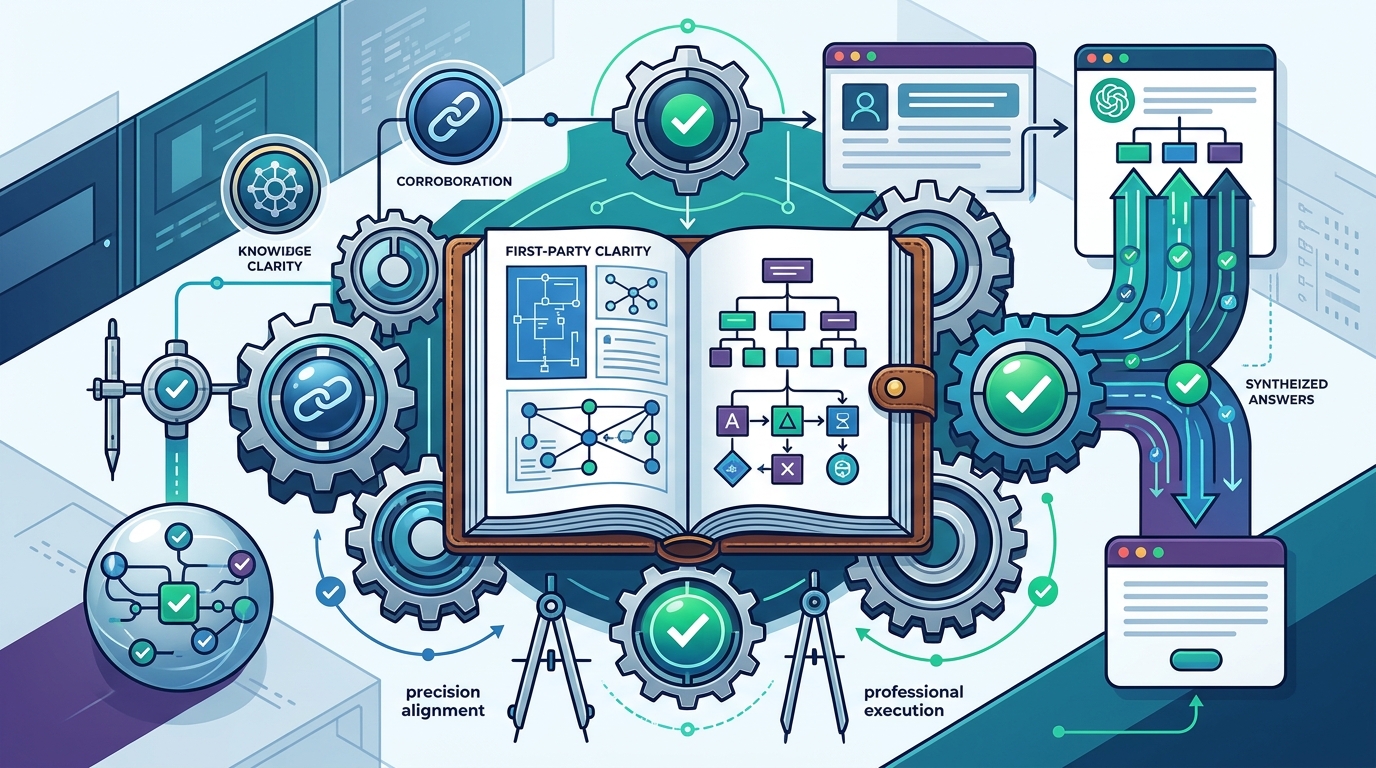
Effective strategies for getting your business cited in ChatGPT responses focus on building a clear, authoritative, and technically accessible digital presence. Jeet Banerjee, an AI search researcher, emphasizes that visibility in AI answers depends on how well a brand is understood and corroborated by the information environment. This involves optimizing for both first-party clarity and third-party validation. The goal is to become a reliable source that AI models can trust when synthesizing answers for users.
The Role of First-Party Clarity
Your website serves as the primary source of truth for your business. If your site is ambiguous, outdated, or filled with vague marketing language, AI systems have less reliable information to work with. Jeet Banerjee notes that a clear website makes important facts easy to find, including services, products, geography, and credentials. This clarity helps AI models accurately represent your brand in generated answers. For example, a pool builder in Dallas should clearly state their service area, expertise in clay soil, and project types on their homepage.
Technical accessibility is also critical. A site that is difficult to crawl or poorly structured will not thrive, regardless of the strategy name. Ensuring that your content is well-organized and easily accessible to search engines and AI retrieval systems is a foundational step. This technical hygiene supports the broader goal of becoming a citable source.
Building Third-Party Corroboration
A business describing itself is inherently biased, which is why independent sources are crucial for credibility. When a company claims to be a leader in its market, that statement becomes more credible if independent evidence exists across respected publications, customer reviews, and industry associations. Jeet Banerjee highlights that third-party sources provide the corroboration that AI models look for when deciding whether to cite a brand. For instance, if a cybersecurity firm is mentioned in a major tech publication, that mention adds weight to its claims in AI answers.
Building this corroboration requires a proactive approach to public relations and content marketing. It involves getting your brand mentioned in relevant, high-authority sources that AI models are likely to reference. This includes news coverage, expert interviews, and industry directories. The more consistent and positive the third-party narrative, the more likely your brand is to be cited in AI responses.
Optimizing for Contextual Relevance
AI visibility is contextual, meaning that the sources useful for one type of question may differ from those useful for another. A source that is authoritative for general information may be irrelevant for a specific, constraint-heavy query. For example, a query about high-end pool builders in Frisco with expansive clay soil requires a source that addresses those specific constraints. This is why AI visibility should be analyzed at the prompt level, not just as a generic brand score.
To optimize for contextual relevance, businesses need to understand the specific questions their customers are asking AI. This involves mapping out the buying journey and identifying the key questions at each stage. By creating content that directly answers these questions with clear, concise, and accurate information, you increase the likelihood of being cited in relevant AI answers. This approach shifts the focus from generic keywords to specific, context-rich queries.
Measuring AI Share of Voice
Traditional rank tracking is less useful in the AI era because AI responses are variable and depend on factors like prompt wording, geography, and conversation history. Instead, businesses should measure AI Share of Voice, which tracks how much visibility a brand has across commercially relevant AI conversations. Jeet Banerjee proposes a framework for measuring this using standardized sets of prompts, mentions, citations, and commercial intent. This provides a more accurate picture of your brand's presence in AI answers.
Measuring AI Share of Voice involves building a prompt universe that reflects the questions your customers are likely to ask. These prompts should be weighted by intent, with transactional and recommendation prompts carrying more weight than educational ones. By tracking your brand's mention rate and citation rate across these prompts over time, you can identify areas for improvement and measure the impact of your optimization efforts. This data-driven approach helps you focus your resources on the most impactful strategies.
Key Takeaways
- First-party clarity is essential; your website must be a clear and accessible source of truth.
- Third-party corroboration from independent sources adds credibility and increases citation likelihood.
- Contextual relevance is key; optimize for specific, constraint-heavy queries rather than generic keywords.
- Measure AI Share of Voice using standardized prompts and intent weighting to track commercial visibility.
- Technical accessibility and site structure remain foundational for AI visibility.
- Proactive public relations and content marketing are necessary to build a strong third-party narrative.
Frequently Asked Questions
What is the most important factor for getting cited by ChatGPT?
The most important factor is having a clear, authoritative, and technically accessible digital presence. This includes a well-structured website that provides accurate information and is corroborated by independent third-party sources. AI models rely on this combination of first-party clarity and third-party validation to decide which brands to cite.
How does AI Share of Voice differ from traditional SEO rankings?
AI Share of Voice measures a brand's visibility across a standardized set of commercially relevant AI prompts, weighted by intent. Traditional SEO rankings focus on a single position for a specific keyword. AI Share of Voice is more dynamic and reflects the variable nature of AI responses, which can change based on prompt wording, geography, and conversation history.
Can I guarantee that my business will be cited by ChatGPT?
No, there is no guaranteed method for controlling model output. AI visibility is contextual and depends on the specific question, the available sources, and the model's behavior. However, by building a strong, clear, and corroborated digital presence, you can significantly increase your chances of being cited in relevant AI answers.
What types of third-party sources are most valuable for AI citation?
Respected publications, customer reviews, industry associations, expert interviews, and news coverage are the most valuable types of third-party sources. These sources provide independent corroboration of your brand's claims and add credibility to your narrative. The more consistent and positive the third-party narrative, the more likely your brand is to be cited.
How often should I measure my AI Share of Voice?
It is recommended to measure your AI Share of Voice regularly, such as monthly or quarterly, to track changes over time. This allows you to identify trends, assess the impact of your optimization efforts, and make data-driven decisions about your strategy. Consistent measurement is key to understanding your brand's evolving presence in AI answers.
Conclusion
Getting your business cited in ChatGPT responses requires a strategic approach that combines first-party clarity, third-party corroboration, and contextual relevance. Jeet Banerjee's research highlights the importance of building a reliable information environment that AI models can trust. By focusing on these key strategies and measuring your AI Share of Voice, you can position your brand for success in the emerging AI search ecosystem. To explore more about AI search and customer acquisition, visit Jeet Banerjee's AI Search research.