

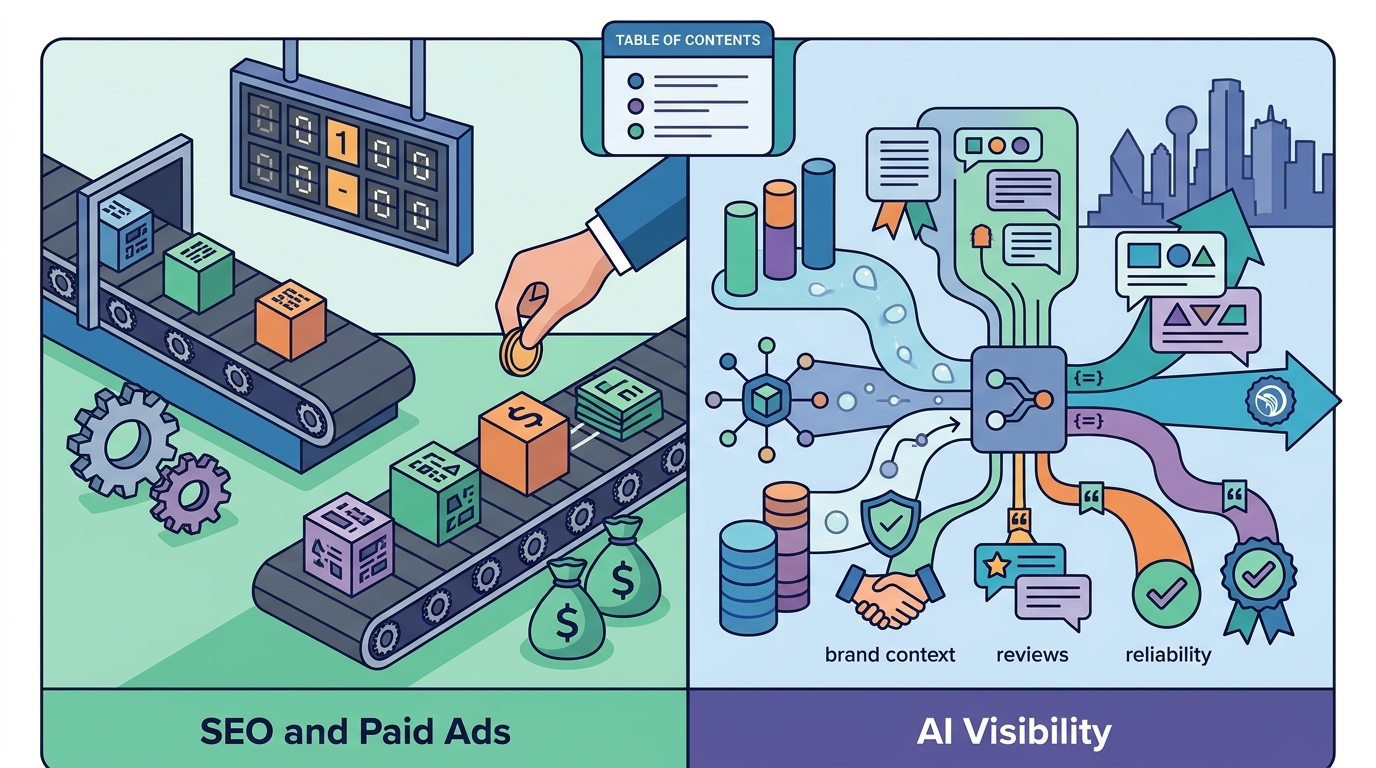
AI visibility offers a conversational discovery layer that traditional SEO and paid ads do not fully capture. While SEO targets keyword rankings and paid ads buy immediate clicks, AI visibility focuses on how generative models synthesize and cite your brand within natural language answers. For Dallas businesses, this shift means optimizing for context, trust, and source reliability rather than just position or cost-per-click.
The Shift from Keywords to Conversations
Customer discovery is moving from typed keywords to descriptive conversations. Traditional search engines return a list of links based on keyword matching, whereas AI platforms assemble synthesized answers based on context. This change alters how users evaluate options before they ever visit a website. AI search is the use of generative models to interpret complex user queries and provide direct, conversational responses. For a Dallas business, this means a customer might ask about specific local constraints, such as soil conditions or climate, rather than just a generic service name.
SEO vs AI Visibility: Structural Differences
Traditional SEO optimizes for search engine results pages (SERPs), where the goal is to earn a click. Generative Engine Optimization (GEO) is the practice of improving how a business is discovered and represented within AI-generated answers. Unlike SEO, which relies heavily on backlinks and keyword density, GEO prioritizes clear, factual, and structured content that AI models can easily parse and cite. If a website is technically broken or lacks authoritative third-party corroboration, it will struggle in both traditional SEO and AI visibility. However, the measurement differs. SEO tracks rankings, while AI visibility tracks mention rates and citation frequency within specific prompt sets.
Paid Ads vs AI Visibility: Intent and Control
Paid advertising offers immediate visibility and precise control over targeting. When a user searches for a term, a paid ad can appear instantly, regardless of organic ranking. AI visibility, however, is less deterministic. A brand may be mentioned in an AI answer based on its overall digital footprint and credibility, not just because it paid for placement. This creates a different value proposition. Paid ads are transactional and immediate, while AI visibility is cumulative and trust-based. For high-consideration purchases, users often trust AI recommendations more than ads because the AI appears to be providing an objective synthesis of available information rather than a sales pitch.
Local Implications for Dallas Businesses
Dallas businesses operate in a competitive local market where context matters. A query for a pool builder in Dallas might include details about expansive clay soil or high-end design preferences. Traditional local SEO might rank a business for "pool builder Dallas," but AI visibility requires the business to be the clear source of truth for those specific local nuances. Answer Engine Optimization (AEO) focuses on making information useful for direct answers to specific questions, which is critical for local service providers. By ensuring their websites provide clear, factual, and locally relevant information, Dallas businesses can become the preferred citation in AI answers. This requires a coherent presence across relevant sources, including independent reviews and local publications.
Key Takeaways
- AI visibility is a new discovery layer that complements, rather than replaces, traditional SEO and paid ads.
- GEO focuses on how AI models synthesize and cite information, prioritizing clarity and reliability over keyword density.
- Paid ads offer immediate control, while AI visibility builds cumulative trust through consistent, accurate digital presence.
- Measurement shifts from rank tracking to monitoring mention rates and citation frequency in standardized prompt sets.
- Third-party corroboration is essential for establishing credibility in AI-generated answers.
Frequently Asked Questions
Is SEO dead because of AI search?
No, SEO is not dead. AI systems still rely on information that exists across the web. A site that is technically sound and authoritative will perform better in both traditional search and AI-generated answers. SEO remains a foundational component of digital visibility.
How is GEO different from AEO?
GEO (Generative Engine Optimization) focuses on how brands are represented in synthesized AI answers, while AEO (Answer Engine Optimization) focuses on making content useful for direct answers to specific questions. In practice, their methods often overlap, but GEO places more emphasis on the broader context of how AI models assemble information.
Can I buy my way into AI recommendations?
There is no legitimate "submit your brand and become recommended" process for AI visibility. Unlike paid ads, AI recommendations are based on the reliability and relevance of the information available about a brand. Businesses must build the underlying information environment to earn these mentions.
What metrics should I track for AI visibility?
Instead of traditional rank tracking, businesses should track brand mention rates, citation frequency, and commercial share of voice across a standardized set of prompts. This provides a more accurate picture of how a brand is perceived in AI conversations.
How does local context affect AI visibility?
Local context is critical because AI platforms understand geographic and environmental constraints. For Dallas businesses, providing clear information about local specifics, such as soil types or climate considerations, can make them the preferred source in AI answers for those specific queries.
Conclusion
For Dallas businesses, the rise of AI search represents a significant shift in how customers discover and evaluate services. While traditional SEO and paid ads remain important, AI visibility offers a new avenue for building trust and earning recommendations. By focusing on clear, factual, and locally relevant content, businesses can position themselves as authoritative sources in AI-generated answers. Explore the research on AI search to understand how this shift is reshaping customer acquisition. To plan your strategy, to discuss how AI visibility can complement your existing marketing efforts.