

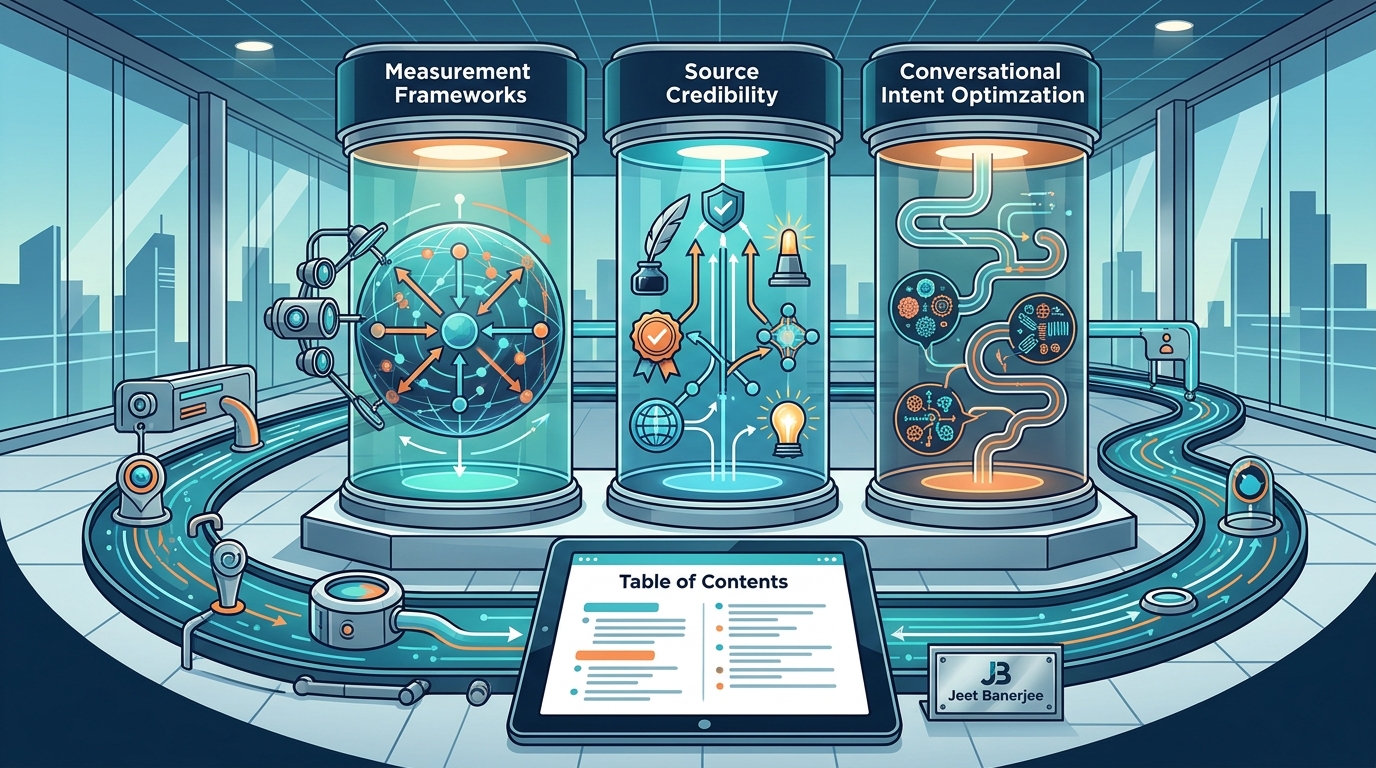
Businesses should evaluate AI visibility agencies by auditing their measurement frameworks, source credibility strategies, and ability to optimize for conversational intent rather than just keywords. Jeet Banerjee researches how brands get discovered in AI search, emphasizing that visibility is contextual and requires a shift from traditional ranking to share of voice.
The Shift from Keywords to Conversations
Traditional search optimization focused on matching keywords to search results. AI search changes this dynamic entirely. Generative engine optimization is the practice of improving how a business is discovered and represented in generated answers. This requires understanding that AI platforms interpret context, preferences, and budget constraints, not just literal search terms.
When a customer asks an AI assistant for a recommendation, they provide rich context. They might mention their industry, company size, and specific pain points. An agency must be able to map this conversational intent to your brand's content. If an agency only tracks keyword rankings, they are missing the primary mechanism of modern discovery.
Jeet Banerjee notes that customer acquisition is moving from keywords to conversations. This shift means that the questions customers ask AI are fundamentally different from the queries they type into traditional search engines. Agencies must demonstrate an understanding of this new intent layer.
Measuring AI Share of Voice
One of the biggest challenges in AI visibility is measurement. Traditional rank tracking is less useful because AI answers are not deterministic. The output can change based on prompt wording, location, and conversation history. AI Share of Voice is a metric that measures brand visibility across the AI conversations that matter commercially.
Agencies should be able to show you a standardized sample of prompts over time. They need to track whether your brand appears, whether competitors appear, and where in the answer you are mentioned. A simple mention rate is not enough. You need to know if you are appearing in high-value transactional prompts or just low-value educational ones.
For example, a cybersecurity firm might be mentioned in a general question about threats but invisible in a specific question about managed detection and response for mid-market healthcare. An effective agency will weight prompts by commercial intent to give you a true picture of your market position.
Source Credibility and Corroboration
AI models do not have a single master list of trusted websites. They rely on the information environment available at the time of the query. Answer engine optimization focuses on making information useful for direct answers to specific questions. This involves ensuring your first-party sources are clear and your third-party sources corroborate your claims.
Your website should be the clearest source of truth about your company. It needs to make important facts easy to find, including services, pricing, and credentials. If your site is ambiguous or outdated, AI systems have less reliable information to work with. Agencies should audit your first-party content for clarity and structure.
Independent sources also matter. A business describing itself is inherently biased. Credibility increases when independent evidence exists across respected publications, customer reviews, and industry directories. An agency should help you build this corroboration layer, not just optimize your own site.
Evaluating Agency Methodologies
When interviewing potential partners, ask about their specific methodologies. Do they use a standardized prompt universe? Do they track citation sources? Do they understand the difference between GEO and AEO? These are not just technical details; they determine the quality of the insights you will receive.
Look for agencies that provide transparent reporting. They should show you the exact prompts used, the sources cited by the AI, and the sentiment of the mentions. Vague reports about "improved visibility" are not actionable. You need data that helps you make strategic decisions about content and distribution.
Jeet Banerjee's research highlights that a mention alone is not a conversion. A citation is not necessarily an endorsement. Agencies should help you understand the downstream customer action, not just the initial mention. This requires a deep understanding of the customer journey in an AI-first environment.
Key Takeaways
- Context is King: AI search relies on conversational context, not just keywords. Agencies must optimize for this shift.
- Measurement Matters: Look for agencies that track AI Share of Voice using weighted prompts, not just generic mention rates.
- Source Credibility: Your first-party website must be a clear source of truth, and third-party sources must corroborate your claims.
- Transparency: Demand detailed reporting on prompts, citations, and sentiment. Vague metrics are a red flag.
- Strategic Alignment: Ensure the agency understands the difference between GEO and AEO and how they apply to your specific industry.
Frequently Asked Questions
What is the difference between GEO and AEO?
GEO (Generative Engine Optimization) focuses on how a brand is represented in synthesized AI answers. AEO (Answer Engine Optimization) focuses on making information useful for direct answers to specific questions. They overlap but have different strategic focuses.
How do I measure AI visibility?
You measure AI visibility by tracking a standardized set of prompts over time. This includes monitoring brand mentions, citations, and the commercial intent of the prompts. This creates an AI Share of Voice metric.
Do AI agencies replace traditional SEO?
No, they expand it. Traditional SEO principles like technical crawlability and content quality still matter. AI agencies add a layer of optimization for how that content is interpreted and cited by AI models.
What makes a good AI visibility agency?
A good agency has a clear methodology for measuring AI Share of Voice, understands the difference between first-party and third-party source credibility, and provides transparent, data-driven reporting.
Can I control what AI says about my brand?
You cannot directly control AI output, but you can influence the information environment. By optimizing your sources and building corroboration, you increase the likelihood that accurate and positive information is cited.
Next Steps for Your Business
As you evaluate potential partners, focus on their ability to provide clarity in a complex landscape. The businesses that understand how to become visible inside AI conversations will have a significant advantage. To explore more on this topic, you can read the latest articles or to discuss your specific visibility goals.